


PID control in your espresso machine - more control, more taste
Espresso is a science in itself. And as with any good science, every degree counts. Even minimal temperature fluctuations can completely change the taste of your espresso. Too hot and the espresso tastes bitter. Too cold, and the aromas remain pale and unbalanced. That's why temperature stability is one of the most important ingredients for consistently good espresso.
A PID control can help. We explain what a PID control is, how it noticeably improves your espresso quality and why it is absolutely worth taking a look under the hood of your espresso machine.
What is a PID control? Technology for consistently good espresso
It sounds like rocket science, but it's a simple upgrade for your espresso enjoyment: PID stands for Proportional-Integral-Derivative - a control technology that originally comes from industry and can now also be found in many premium espresso machines.
The PID control regulates the temperature in the boiler or directly at the brewing water with high precision and constant readjustment. While conventional thermostats often work on the principle of "heat up to a certain point and then switch off", the PID thinks for itself: An integrated sensor constantly measures the temperature and an algorithm calculates how much and for how long additional heating is required based on previous fluctuations.
This gives you a perfectly stable brewing temperature without any major fluctuations - ideal for consistent extraction, especially for several espressos in a row.
P-I-D: The smart trio for the perfect brewing temperature
The PID control is the heart of temperature control - but what is actually behind these three letters?
- P for Proportional: This component analyzes the difference between the actual and set temperature. If the difference increases, the control system intervenes. So if it suddenly gets too hot, countermeasures are taken immediately.
- I for integral: This part reacts to long-term temperature fluctuations. It takes past values into account, compensates for small deviations and ensures that the temperature remains stable at the target value.
- D for Derivative: The D component recognizes in which direction the temperature is developing before it is too late. If the temperature rises too quickly, preventive counter-regulation takes place.
These three parameters work together to keep the temperature in the boiler stable - a real secret weapon for consistently good extraction with every shot.

Why PID control is really worthwhile
Without PID control in your espresso machine, the temperature in the boiler can fluctuate considerably. This sounds harmless, but it means that the taste of your espresso can vary from shot to shot.
An espresso machine with PID control provides significantly more control and therefore better taste.
01
Constant brewing temperature = constant taste
Temperature fluctuations are the arch enemy of a successful extraction. Even minimal deviations can tilt the aroma. A PID control system keeps the temperature just right. This not only makes life as a home barista less stressful, but also much more enjoyable.
02
Fine-tuning for every bean
Fruity natural, nutty-chocolaty blend or lightly roasted single origin - every bean has its very own feel-good temperature. With a PID control, you can set this precisely and get the full flavor out of your bean.
03
Energy efficiency and machine protection
Constant control means less extreme reheating, less strain on the heating elements and therefore a plus for the longevity of your machine. Not only do you get great coffee, but you also save electricity and protect the environment.
PID control for home baristas: must-have or gimmick?
Although a PID control in the espresso machine is not a must, it is a real recommendation for certain user groups. Ambitious home baristas and true professionals in particular benefit noticeably from the precise temperature control. Anyone who regularly experiments with different roasts or wants to extract particularly fine nuances will quickly taste the difference.
The PID control is particularly exciting in relation to the different degrees of roasting. This is because the darker or lighter the roast, the more sensitive they are to temperature fluctuations. A well-adjusted PID control can therefore make the decisive difference between "quite good" and "wow". Medium roasts, on the other hand, can cope better with temperature deviations. A PID upgrade is therefore more of a "nice-to-have" here.
There are also technical limits: PID systems show their full potential in machines with a large boiler and 58 mm brew group, for example in dual boilers. In smaller appliances with a 57 mm brew group and smaller boilers, temperature stability is limited anyway. Here, a PID upgrade often brings hardly any noticeable improvements.
In short: If you regularly tweak your espresso or like to prepare light roasts, you should consider a PID upgrade. For everyone else: it works without - just not quite as precisely.
QuickMill
QuickMill - compact, clever, PID included
The Italian brand QuickMill stands for smart solutions with style - and already offers PID technology in its space-saving single-circuit coffee machines:
- QuickMill POP - Modern design, PID control and thermoblock.
- QuickMill Emilia - With PID control, stainless steel housing and wooden details.
- QuickMill New Sebastiano - Dual boiler for precise brewing and steam power deluxe.

Quick Mill New Emilia PID Special Edition

Quick Mill Sebastiano New PID Special Edition Black

Quick Mill 02043 Pop! Black
The original price was: €945.00799,00€The current price is: 799.00€.Profitec
Profitec - Technology for fine tuning
Profitec combines high-quality workmanship with sophisticated technology - PID control is standard here:
- Profitec GO - compact single-circuit coffee maker with PID: ideal for beginners with high standards
- Profitec the Dualboiler - maximum control for real home baristas

Rocket
Rocket - Italian design, technically top
Rocket is also heavily involved in PID machines - but not in all models:
- Rocket Cinquantotto - dual boiler, PID, display - and a real visual highlight.
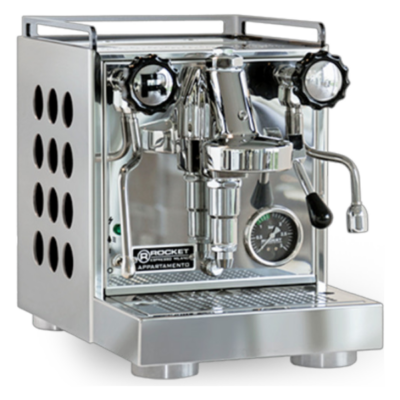
- For comparison: Rocket Appartamento - a classic without PID, but with a solid HX system.
ECM
ECM - PID control meets German engineering
Precision is a top priority at ECM - and this is also evident in the temperature control:
- ECM Classika - compact single-circuit coffee maker with PID control
- ECM Technika V Profi - dual-circuit boiler with PID and E61 brew group
- ECM Synchronika - dual boiler with two PID controls


PID control: The key to the perfect espresso
Whether you are just starting out in the world of espresso or have been looking for the perfect shot for a long time - a PID control brings you closer to your goal. Because if you control the temperature, you control the taste.
An espresso machine with PID control offers real advantages, especially for demanding roasts or frequent changes of coffee type. And the best thing is: you don't have to be a technology nerd to benefit from the precision. Operation is often simple and the effect is noticeable and visible.
Want to know how a PID control affects your espresso? Then come and see us - in our stores or directly online! In our Espresso Perfetto Shop you will find a large selection of espresso machines with PID control - from QuickMill and Profitec to ECM PID control.