




What is a stainless steel boiler in portafilter machines, and who should consider it?
In most portafilter machines, a boiler heats the water for the espresso and also generates the steam used to froth the milk. It is usually made of stainless steel, copper, or brass. The material used primarily affects how long the machine will last and how much maintenance it requires.
A stainless steel kettle is considered particularly durable, but it generally takes a little longer to heat up than a copper kettle. Here, you’ll learn how the kettle works, how stainless steel differs from copper and brass, who it’s best suited for, and how to care for it.
What does the boiler do in a portafilter machine?
The boiler is a pressure-resistant vessel that is electrically heated and controlled by a thermostat or a PID controller.
Depending on the machine's design, there are three boiler types:
- Single-circuit system: One boiler supplies either the brew group or the steam wand. Therefore, brewing and frothing milk at the same time is not possible.
- Dual-circuit (heat exchanger): The boiler is heated to steam temperature. The brewing water flows through a tube in the boiler, heating up to brewing temperature in the process. This allows you to brew espresso and froth milk at the same time.
- Dual boiler: Two separate boilers are each controlled by their own heating system. Brewing and frothing can be done simultaneously, and the brewing temperature remains exceptionally stable.
How do brass, copper, and stainless steel boilers differ?
| Property | Brass | Copper | Stainless steel |
|---|---|---|---|
| Thermal Conductivity | Approx. 100–120 W/(m·K) | Approx. 400 W/(m·K) | Approx. 15 W/(m·K) |
| Corrosion Resistance | Okay, but in water high in chloride, brass can lose its zinc content | Well, it depends on the water quality | Very high, but with high chloride levels there is a risk of pitting corrosion |
| Metal Leaching into Water | Possible (copper, zinc, and—in older alloys—lead) | Possible (copper ions) | Very low |
| Maintenance requirements | Higher | Higher | Low |
Stainless Steel Boilers: Durable and Easy to Maintain
Stainless steel is an iron alloy containing at least 10.5% chromium. The chromium forms a thin layer of chromium oxide on the surface, which protects the metal from corrosion. As a result, the boiler can handle a wide range of water qualities.
However, its thermal conductivity is significantly lower than that of copper or brass, which is why the machine takes longer to heat up.
Copper kettles: fast and heat-conductive
Copper conducts heat more than 25 times better than stainless steel. A copper boiler distributes heat quickly and evenly, so the machine is ready for use sooner. However, depending on water quality, copper can corrode and release copper ions into the water; therefore, appropriate water hardness and regular maintenance are important. Copper boilers have proven themselves over many years and are used in numerous high-quality portafilter machines.
Brass Kettles: The Happy Medium
Brass is an alloy of copper and zinc, and its thermal conductivity falls between that of copper and stainless steel. In soft, chloride-rich water, the zinc can leach out, causing the material to become porous. In portafilter machines, brass is often used for brew groups and fittings, but less commonly for the boiler.
Does the material of the kettle affect the taste?
Only to a small extent. Stainless steel, copper, and brass all produce equally good espresso when properly maintained. The most important factors are freshly ground beans, medium-hard water, a consistent brewing temperature, and a clean machine. The material of the boiler primarily affects heating time, durability, and maintenance requirements.
What are the advantages of a stainless steel boiler?
- High corrosion resistance due to the protective chromium oxide layer
- Virtually no metal leaching into the water
- Long service life with proper care
- Low maintenance requirements for the boiler itself
What are the disadvantages of a stainless steel boiler?
- Longer warm-up time: In everyday use, this isn't a big problem—you just need to allow a little more time.
- Limescale still builds up: As with any boiler material, the extent of the buildup depends on the water hardness.
Which machines at Espresso Perfetto have a stainless steel boiler?
| Boiler Type | Models |
|---|---|
| Single-circuit | ECM Puristika, ECM Classika II, ECM Classika III Fast Heat, Olympia Express Cremina and Cremina SL |
| Dual-circuit | Izzo Leo, Quick Mill Naz, Quick Mill New Emilia PID, Profitec Pro 400, ECM Mechanika VI Slim and Mechanika VI Slim PID, ECM Mechanika Max II Fast Heat, Olympia Express Maximatic and Maximatic 2 |
| Dual Boiler | Quick Mill New Sebastiano PID, ECM Technika VI, Profitec Ride and Pro700 Drive, ECM Synchronika II Fast Heat and Estetika Fast Heat, Mahlkönig Xenia Brew by Sync, La Marzocco Linea Mini R Foodservice: La Marzocco Linea PB/PBX, KB90, and GB5, Kees van der Westen Speedster |




* Savings compared to the manufacturer's suggested retail price (MSRP) or, in the case of "Instead of" prices, compared to our previous price.


* Savings compared to the manufacturer's suggested retail price (MSRP) or, in the case of "Instead of" prices, compared to our previous price.


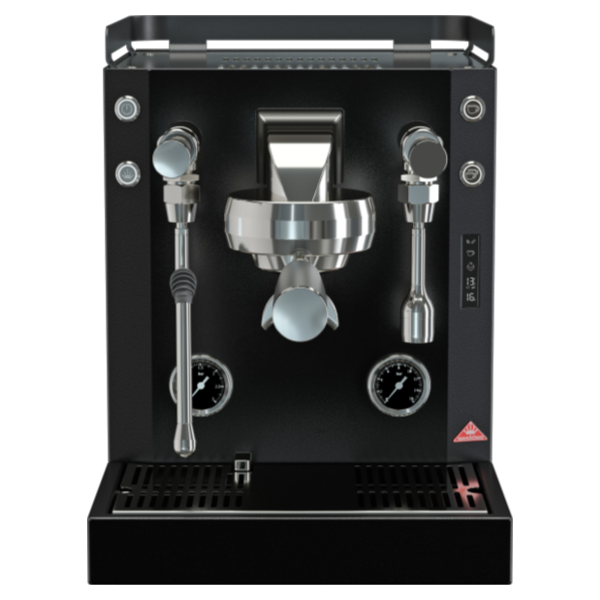

* Savings compared to our previous price.


How do you care for a stainless steel kettle?
The most important step in maintenance is regular descaling. Only chloride-free descaling agents are suitable for stainless steel kettles—in other words, no hydrochloric acid-based products.
| Action | How often | What it offers |
|---|---|---|
| Fill with fresh water, clean the tank | Every day | Prevents buildup and bacteria in the tank |
| Portafilter, Clean the filter and brew group | Every day | Removes coffee residue and oils |
| Backflush the brew group | Weekly to monthly, depending on usage | Removes coffee grease from the valve and lines |
| Descaling according to the manufacturer's instructions | Depending on water hardness and usage | Keeps heating elements, boilers, and pipes free of limescale |
| Professional Maintenance | Every 2 to 4 years (home use) Every 6 months (food service) |
Checks the seals, pump, thermostat, and pressure gauge |


* Savings compared to our previous price.
Who should consider a stainless steel kettle?
A stainless steel boiler is ideal for anyone looking for a durable and low-maintenance portafilter machine who is willing to accept a slightly longer heat-up time. If a short heat-up time is your top priority, a copper boiler is the better choice.
Espresso Perfetto offers portafilter machines with stainless steel, brass, and copper boilers in the online store and at several local stores. The service centers in Düsseldorf, Erkrath, and Bochum handle maintenance, descaling, and repairs, including for machines with stainless steel boilers.