



Effective tips for preventing limescale build-up in your espresso machine
Anyone who cleans their espresso machine usually wants to improve hygiene when drinking espresso. This involves removing coffee grounds, mold spores and bacterial residues. All of this can be removed with food-safe hygiene cleaners. It is much more difficult when it comes to removing limescale from the espresso machine. Calcification is stubborn and requires special agents and techniques to remove. It is therefore advisable to prevent the build-up of limescale in the espresso machine in order to save time and energy. However, to prevent limescale build-up in the coffee machine, we must first get to the bottom of the causes.
Why is my espresso machine calcifying?
Limescale deposits enter the espresso machine through the water and settle wherever the water comes into contact with the machine. You can find out whether your water is particularly hard by looking at its hardness. Water with a hardness of 14 degrees dH or more is said to be particularly hard. You can easily determine the degree of hardness of your water using special test strips.
The water that you use for your espresso machine is heated and then evaporates. The evaporation process leaves only the minerals in the form of limescale, which adhere to the individual components of the espresso machine.

These residues are not dangerous to your health. However, they can spoil the taste of your espresso.
What effects do limescale deposits have on my espresso?
An espresso from a calcified espresso machine usually tastes cold and sour. This is because the water can no longer run evenly through the sieve and is no longer heated evenly. As a result, too few bitter substances are released from the espresso beans so that they can no longer balance out the acidity. The espresso therefore becomes undrinkable. Loud pumping noises are also a sign of a calcified espresso machine. This occurs when the water can no longer flow freely through the pipes.
If this is already the case for you, we will help you step by step to a limescale-free espresso machine in this blog.
How do I descale my espresso machine?
Regular descaling of your espresso machine is essential. If the limescale is not removed regularly, this can accelerate the wear and tear of the espresso machine, which will be much more expensive in the long run than the descaling itself.
So how do you descale your espresso machine properly? We have examined household remedies, professional descaling agents and various descaling techniques for you. First, let's take a closer look at the home remedies.
Home remedies for descaling your espresso machine?
There are home remedies for EVERYTHING: home remedies for smooth hair, home remedies for blocked kitchen drains and home remedies for descaling. Vinegar, citric acid and baking soda are particularly popular for this - a magic remedy AGAINST & FOR EVERYTHING.
According to the logic of chemistry, the use of acid on limescale is not so bad. On the contrary, because limescale has been proven to dissolve with the help of acid. If we now use vinegar as an acid, we have the disadvantage that the taste settles in the pipes of the espresso machine. True coffee lovers are not satisfied with this. In addition, the acid in the vinegar can even be so aggressive that the seals or other plastic parts are damaged. Vinegar should therefore be used with caution when descaling coffee machines.
What about citric acid? Citric acid is gentler than vinegar and therefore less aggressive. However, citric acid contains calcium citrate, a tasteless, crystalline solid. As the espresso machine can only be descaled with liquids, you would also have to use citric acid together with water. The next step would be to heat up the espresso machine and run the brew through all the pipes.
When heated, a large proportion of the water evaporates, the heavy solid calcium citrate can no longer be flushed out and is deposited in the same way as limescale. Calcium citrate deposits are even more serious than the gradual build-up of limescale. This is because calcium citrate can block pipes and valves in a very short time, meaning that expensive repairs are no longer an option. You should therefore never use pure citric acid, but only high-quality citric acid-based descaling agents that can dissolve and flush out the calcium citrate directly during the descaling process.
Now we come to the famous myth of baking powder. A quick recap: acid is needed to dissolve limescale, but it should not be too aggressive and should not be deposited in the form of solids. This means that the substances contained in the household remedy must dissolve completely in water, otherwise they cannot be flushed out through narrow valves and pipes. Baking soda does NOT have any of these properties! It contains no acid and does not even dissolve in water. Well, that's it for the good old household remedies. An espresso machine is a technically sophisticated appliance and also requires special care.
So here are our recommendations for professional descaling agents.
The best professional descaling agents for your espresso machine
Professional descaling agents are available in both liquid and powder form. The powders must first be dissolved in water, while descaling agents in liquid form are already ready for use.
Espresso Perfetto has developed a liquid descaling agent based on citric acid that gently removes limescale residues from your espresso machine without creating calcium citrate deposits. It can be used on instantaneous water heaters, boilers, valves, pipes and heating rods. It is also suitable for espresso and coffee machines, fully automatic machines, kettles, steam irons and much more. The descaler from Espresso Perfetto for €15.00 is therefore a worthwhile investment, as it can be used in many different ways.
If you prefer descaler in powder form, we can recommend the Clean Boiler and the Puly Cleaner. 1kg of Clean Boiler powder is available in our store for €19.90. This is an extremely gentle, highly concentrated descaling agent that is therefore perfect for your portafilter machine.
We recommend the Puly Cleaner from our online store as a 2-in-1 product. This is also a descaling powder that is not only suitable for descaling, but also removes coffee grease and coffee oils from the brew group. It is available in 10 x 30g packets, each of which is dissolved in one liter of water. The solution is then poured into the machine's water tank and runs through automatically. At the end of the descaling process, the water tank must be refilled with normal water and the pump should be activated again until all the water has run through.
How often you need to descale your espresso machine depends on various factors. On the one hand, the frequency of use plays a role, but also the hardness of your tap water. However, as a rule of thumb, we recommend descaling after every 200 brews. Espresso machines that are equipped with a descaling indicator must be programmed according to the water hardness. To do this, the water hardness must first be determined. If the water is softer than 14 degrees dH, the machine must be descaled at least twice a year. If the water hardness is 14 degrees dH or higher, the espresso machine should be descaled approximately every three months. The respective water hardness can influence the degree of limescale build-up in kitchen appliances and this is the key to preventing limescale deposits in the coffee machine.
The limescale content can be reduced using bottled still water, various filters for tap water and water softeners. However, the most cost-effective solution is the filter method. A filter has a long service life and the water can still be used generously for the espresso and coffee machine, the kettle and for the glass directly from the tap.
One example is the BWT BESTMAX PREMIUM S FILTER CARTRIDGE from our online store. Depending on the size and accessories, it is available from us from a price of € 90.00. This filter cartridge eliminates chlorine, impurities and heavy metals without leaching out valuable minerals such as magnesium. The integrated limescale protection also greatly improves the taste quality of your coffee drinks.
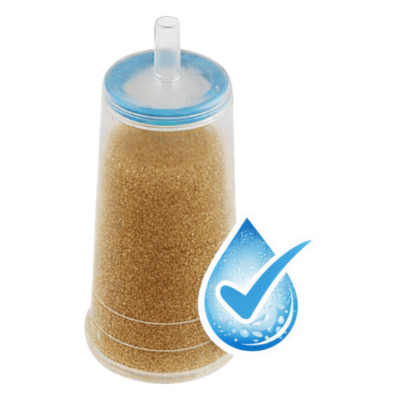
In addition to filters that filter the water directly from the tap, such as the BWT BESTMAX PREMIUM S FILTER CARTRIDGE, there are filters that are inserted directly into the espresso machine and filter the water immediately before the brewing process. One such insert is the ECM water filter suction cartridge kit. The filter cartridge is fitted with an aroma ring that can be individually adjusted to the regional water hardness. The kit contains a test stick to determine the water hardness. The kit is suitable for ECM machines with rotary and vibration pumps. The adapter of the ECM water filter can only be used with espresso machines from the IVer series, Synchronika and the Classika II/PID.
Another model that is inserted directly into the espresso machine is the NICAL 125 water filter, which is attached to the intake hose and makes a lasting contribution to the maintenance of any espresso machine.
The best cleaning and descaling agents in our store
We know that maintaining an espresso machine can be time-consuming, but we guarantee that you will be rewarded for it! With intensive care, you can give your espresso machine a long life without repairs and your palate will also thank you, because a well-maintained espresso machine produces the best coffee flavors in your espresso.
In our store we equip you with high-quality cleaning and descaling agents so that you can benefit from your coffee machine for a long time.