




Is it better to buy coffee beans online or in person?
Both have their advantages. If you're not sure yet which coffee bean with which flavor profile is right for you, you can check out our online store. There, we describe the specific flavors of our different coffee varieties.
If you’d like to try the flavors in person, you can either stop by one of our locations or simply order a sample pack at a special price. The latter option has the advantage of letting you see firsthand how each bean performs and how you can adjust your coffee grinder and portafilter to get the most out of the coffee beans.
Every now and then, our online store even features special offers that let you save a little money. So it's worth subscribing to our newsletter to make sure you never miss an offer again.
Order coffee beans and barista supplies right now from the comfort of your own home in our online store.

Does Espresso Perfetto also carry decaf?
Yes, Espresso Perfetto also offers a decaffeinated coffee bean blend under its own brand. It consists of a blend of 90% Arabica and 10% Robusta and is available in 500-gram packages in the online store or in-store.
Does " Espresso Perfetto " offer fair-trade beans?
The Decaffeinato and Organic Fairtrade coffee varieties bear the Fairtrade seal. Both varieties meet international Fairtrade standards.
Does Espresso Perfetto sell organic beans?
Both our "Espresso Perfetto " organic Fairtrade coffee beans and our " Espresso Perfetto " organic decaffeinated coffee bear the organic certification label, which is governed by the EU Organic Regulation.
Decaf – a low-caffeine alternative for coffee lovers
Decaffeinated coffee—also known as decaf —is the ideal alternative for anyone who enjoys the aroma and taste of coffee but wants to reduce their caffeine intake. The decaffeination process is key to the quality of the coffee: Gentle methods, such as the CO₂ or Swiss water processes, preserve the aromas, while chemical processes can leave residues and affect the taste.
There are many reasons to switch to decaffeinated coffee:
- Sleep Problems After Drinking Coffee in the Evening
- High blood pressure or other cardiovascular diseases
- Unpleasant physical symptoms after consuming caffeine
- A sensitive stomach that reacts to acid
- Pregnancy and/or breastfeeding
Nevertheless, it is important to consider how the coffee beans were decaffeinated, as the various methods affect the quality of the beans to varying degrees.
How are coffee beans decaffeinated?
Not all decaf is the same, because various methods can be used to decaffeinate coffee beans. Most commonly, these include the carbon dioxide method, the Swiss Water process, or chemical methods.
You'll now learn exactly how each of these processes works and what that might mean for your purchasing decision.
Carbon Dioxide Process / CO₂ Process
In this process, the coffee beans are first soaked in water until they swell and their pores open. The CO₂ then passes through the coffee beans under high pressure and at a temperature of about 31 °C. During this process, the CO₂ is in a so-called supercritical state, which has the advantage of extracting mainly the caffeine while preserving other chemical components, such as flavor compounds. Finally, the CO₂-containing caffeine is directed into a separate container, where the caffeine and CO₂ are separated from one another. This allows the CO₂ to be reused repeatedly.
Advantages:
- Flavors are preserved
- No chemical residues
- Excellent flavor
Swiss Water Process
This natural process, which originated in Switzerland, does not use any chemicals. The unroasted coffee beans are first soaked in warm water, which extracts both caffeine and flavor compounds. At the same time, a coffee extract is produced in which the caffeine and flavor compounds are separated from one another. The extracted portion containing the flavors is crucial for the next step: the next batch of coffee beans, which is soaked in this extract, does not lose its flavors, but only the caffeine.
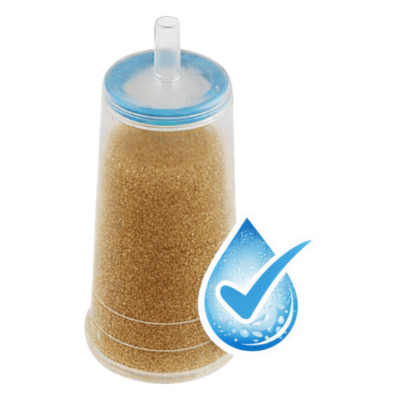
While this isn’t osmosis per se—it is certainly inspired by osmosis. That’s because the concentration of flavors in the extract is so high that it prevents any further release of flavors from the swollen coffee beans. However, there is no caffeine in the extract—thanks to the concentration gradient, the caffeine can escape from the coffee beans and mix into the extract. Later, the caffeine must be removed from the extract again. This is done using a special activated carbon filter through which the water is passed. The “flavored water” is then used for the next batch of beans, creating a cycle that preserves the flavors.
Advantages:
- 100% chemical-free
- Natural Process
- Suitable for organic coffee
Chemical Processes
In this process, the coffee beans are pretreated with water and then processed with solvents such as dichloromethane or ethyl acetate, which extract the caffeine. In short: The caffeine is chemically dissolved and then removed using steam.
This method is particularly inexpensive and requires little effort. However, chemical residues are usually detected in the beans, and the flavors lose some of their intensity.
Advantage: inexpensive, fast, and efficient.
Disadvantage: usually leaves residue, and the taste can be more strongly affected.
A Comparison of Decaf Methods
| Procedure | Advantages | Taste Quality |
|---|---|---|
| Carbon Dioxide Process / CO₂ Process | Flavors are preserved; no chemical residues; high-quality taste; CO₂ is reusable | Very aromatic |
| Swiss Water Process | 100% chemical-free; natural process; suitable for organic coffee; resource-efficient cycle | Natural & Gentle |
| Chemical Processes | Inexpensive; fast and efficient process | Less aromatic |
Note: "Caffeine-free" and "decaffeinated" are not the same thing
Decaffeinated or "decaf" beans contain trace amounts of caffeine. After the decaffeination process, less than 0.1% of the caffeine remains in these coffee beans. This is precisely why "caffeine-free" is not an accurate description.
Is there such a thing as decaf coffee?
To put it simply: It is not yet possible to produce decaffeinated coffee—that is, coffee beans with 0% caffeine. There are certainly decaffeinated alternatives, such as grain coffee—but these are not real coffee made from coffee beans.
Caffè Decaffeinato – Decaffeinated Coffee Beans from Espresso Perfetto
Our decaffeinated coffee beans are organic, which means that no chemical processes were used to remove the caffeine. Our own-brand Caffè Decaffeinato from Espresso Perfetto a blend of 90% Arabica and 10% Robusta beans, sourced exclusively from organic and fair-trade farms in Central America and South Asia. The medium roast offers a rich aroma and is ideal for all coffee lovers who want to reduce their caffeine intake without sacrificing the intense flavor of coffee.

Espresso Perfetto Decaffeinated 500g
* Savings compared to our previous price.
Why does my coffee taste bitter even though I'm using good beans?
Quick Answer:
If your coffee tastes bitter despite using good beans, it could be due to one of the following four factors: over-extraction, water temperature, grind size, and how the coffee beans are stored. To get the best flavor out of your beans, it’s important to check all of these factors.
What does "overextraction" mean in espresso preparation?
Over-extraction occurs when water runs through the ground coffee for too long during the brewing process. In the first few seconds, the desired sweet, malty, fruity, and chocolatey flavors are extracted. After that, the bitter compounds are extracted. If the water runs through for too long, these bitter compounds dominate, and the coffee tastes bitter.
The ideal brewing time depends on the appliance used to prepare the coffee beverage in question.
The Right Brewing Time for My Coffee or Espresso
| Method of Preparation | Brewing time |
|---|---|
| Portafilter machine | 22–25 seconds |
| Espresso maker | About one minute |
| Fully automatic machine | 27 seconds |
| Filter coffee | 3–4 minutes |
| French Press | 4 minutes |
| Cold Brew | 12 hours |
Bitter coffee due to the wrong water temperature
Just like the brewing time, the water temperature should also be adjusted to suit the way you prepare your coffee. If the water temperature is too high, it causes bitter compounds to be released, making the coffee taste bitter.
The Right Water Temperature for Your Coffee Drink
| Method of Preparation | Brewing temperature |
|---|---|
| Portafilter machine | 94°C |
| espresso pot | 99°C |
| Fully automatic machine | 88°C |
| Filter coffee | 95°C |
| French Press | 96°C |
| Cold Brew | Refrigerator temperature |
Bitter Coffee Due to the Wrong Grind Size
Bitter coffee can result from a grind that is too fine. If the grind is too fine, water flows more slowly through the ground coffee, which increases the extraction time and causes the coffee to become over-extracted.
The perfect grind size for Portafilter, fully automatic coffee makers, French presses, drip coffee, etc.
| Method of Preparation | Grind size |
|---|---|
| Portafilter machine | fine |
| espresso pot | fine |
| Fully automatic machine | medium to coarse |
| Filter coffee | medium to coarse |
| French Press | roughly |
| Cold Brew | roughly |
Bitter Taste—Are the Coffee Beans Spoiled?
That's right—a bitter taste in coffee can also be a sign of spoiled coffee beans. Improper storage of coffee beans causes the coffee to become undrinkable in a short amount of time.
The coffee bean itself acts as a natural protective shell for the coffee's aromas. Compared to pre-ground coffee, the aromas in properly stored whole coffee beans last longer.
Myth Alert: There’s a common claim that coffee should be stored in the refrigerator. However, in the refrigerator, coffee is exposed to cold temperatures, foreign flavors, and moisture.
The most common reason for bitter coffee
Over-extraction—that is, when the water runs through the coffee for too long—is the most common direct cause of bitter coffee. However, over-extraction is closely related to the grind size and water temperature.
If water comes into contact with the ground coffee for too long or “too intensely,” this is called over-extraction. This happens, for example, when the coffee is ground too finely, the brewing time is too long, or the water temperature is too high.
How can I tell if there has been over-extraction?
You can tell when coffee has been over-extracted by its strong bitterness. Over-extracted coffee tastes like unsweetened black tea, while sweet, fruity, or chocolatey notes are completely lost.
If the water flows only slowly or not at all through the filter, and the coffee puck is wet and mushy after brewing, this may be a sign of over-extraction.
If the crema is patchy, almost white, or barely there—rather than having a nutty or caramel-like appearance—this is also a sign of an over-extracted espresso.
Coffee beans in a variety of flavors—find your favorite variety
Quick Answer:
Espresso Perfetto coffee beans to suit every taste—from mild and chocolatey to floral and fruity to spicy and tart. In our online store, you’ll find our own brand, Inpetto, as well as Mocambo and Segafredo. Sample packs help you find your favorite variety.
Coffee Varieties for Every Taste – Buy Coffee Online
At Espresso Perfetto , you Espresso Perfetto order coffee beans from various brands and price ranges online. In our online store, you'll find our own brand, Espresso Perfetto Inpetto, Mocambo, and Segafredo.
Our online store really stands out for its wide variety of options, which offers something for every taste—whether you prefer espresso, latte macchiato, coffee, or cappuccino.
If you're interested in the various coffee varieties from Espresso Perfetto , you can start with a sample pack and try all the varieties, pre-packaged in small portions, at a special price.
Our wide selection of coffee beans is suitable for portafilter machines, fully automatic machines, drip coffee, espresso pots, capsule machines, or the French press.
Simply order from the comfort of your home and have it delivered right to your doorstep. That way, you can enjoy Italian coffee in the comfort of your own home without having to carry anything.
Where does the coffee come from?
When it comes to figuring out which coffee flavor suits you best, it’s always a good idea to take a look at the origin of the coffee beans. The so-called terroir has a major influence on the flavor profile of individual coffee bean varieties. A terroir is determined by the climate, soil, altitude, and topography of the coffee bean’s place of origin.
For example, if the coffee plant grows in volcanic soil, the soil’s complex minerality imparts a lively acidity to the beans, while clay soils tend to give them a heavy body.
The climate can promote slow or rapid ripening of the coffee cherries, and rainfall determines the flowering period and, consequently, the concentration of flavors. Slow ripening in shadier regions intensifies the sweetness of the coffee cherry.
If you prefer a less acidic taste and are looking for an earthy note, you should try lowland coffee, because highland coffee has a fruity, mild acidity due to the cooler climate and slower growth.
This also depends on how much sun, water, and wind a coffee plant receives, as well as on the topography—that is, the orientation of the slopes where the plants are grown.
Most Common Regions of Origin for Our Coffee Beans
| Region | Climate | Elevation | Topography | Floor | Flavor Profile |
|---|---|---|---|---|---|
| Central America (e.g., Guatemala) | Tropical and humid, with distinct rainy and dry seasons. | Highlands (1,200–2,000 m) | Steep volcanic slopes, often in the shade of rainforest trees. | Volcanic ash (rich in minerals and fertile). | Lively acidity, subtle chocolate notes. |
| South Asia (e.g., Kaapi Royale) | Extremely high humidity, monsoon rains. | Lowlands to Central Plateau (800–1,500 m) | Wooded hills with mixed crops of pepper and cardamom. | Forest soils rich in humus. | Uniquely spicy, smoky, low in acidity, full-bodied, and chocolatey. |
| East Africa (e.g., Djimma, Ethiopia; Uganda; Sidamo) | Variable humidity, warm days but cool nights. | Extreme Highlands (1,500–2,400 m) | High plateaus, valleys, and slopes | Deep-red volcanic soils | Tart, full-bodied, and spicy. |
| Brazil (e.g., Cerrado) | Subtropical & hardy. | Mittelland (800–1,200 m) | Huge, flat plateaus | Terra Roxa (fertile, red soil). | Floral and wine-like. |
All coffee beans in the product range, sorted by origin


Your Personal Taste Profile
Do you love chocolatey flavors? Or do you prefer floral or fruity ones? How about “spicy, earthy”? If you know what kind of flavor profile you have, we’ve got a few coffee beans here that match your individual taste. And if you haven’t figured out your favorite flavors yet, we’ve got the perfect solution for you, too.
Sweet-tasting coffee beans with no acidity
Sweet coffee beans with low acidity range in flavor from chocolatey to nutty to caramel. For this, we recommend our “Dolce Gusto Series” from Espresso Perfetto the 70|30 blend from our in-house roast. This is because the high proportion of Robusta beans comes from India and imparts a full-bodied, chocolatey flavor with low acidity. Our fair-trade organic beans are just as chocolatey and full-bodied—available both with and without caffeine.
Coffee beans – floral, fruity
Coffee shouldn’t be sour, but a subtle acidic note is very popular and is often described as floral and fruity. Coffee beans with this flavor profile are often enjoyed black, without milk. The slight acidity can often make the milk taste stale. These beans are particularly well-suited for a pure espresso crema. If you prefer this flavor profile, you should definitely try the 80|20 and 90|10 varieties of Espresso Perfetto , as well as our 100% Arabica beans — Abruzzo, Veneto Classico, and Lombardia —from Espresso Perfetto.
Spicy, robust, and bitter coffee beans
This category includes the 60|40 blend from Espresso Perfetto in-house roastery Espresso Perfetto well Espresso Perfetto the Dolce Gusto series, which impresses not only with its sweet, nutty, and chocolatey notes, but also with a bold, tart spiciness that is almost reminiscent of dark chocolate, and an overall well-rounded flavor profile with low acidity.
Which coffee beans are best for espresso?
When it comes to choosing the right espresso beans, it ultimately comes down to personal taste, but also to how well the beans can be ground. Espresso beans must have a texture that allows for a fine, even grind. If they’re too oily, they’ll quickly clump together in the coffee grinder, preventing a consistent grind. Oily beans can be recognized by their shiny surface, whereas non-oily beans tend to be more matte and dry. Medium to dark roasts are best suited for making espresso, as they reduce acidity and bring out the roasted flavors.
Particularly well-suited for espresso preparation: all of our private-label coffee beans, including Bar Gusto, Miscela Classico, Abruzzo 100% Arabica, Organic Fair Trade, and Crema Aroma.
Inpetto's coffee and espresso beans, as well as Mocambo's Gran Bar and Brasilia, are also suitable.
Which coffee beans are best for creamy cappuccinos and milk-based drinks?
Not all coffee beans are suitable for coffee drinks made with milk. First, for drinks like latte macchiato and cappuccino, we recommend coffee beans that are also suitable for espresso. The exception would be milk coffee, which consists of 50% milk and 50% coffee. However, all coffee beans used in milk-based drinks should have one thing in common: they should not have a sour or fruity flavor profile.
A tart, fruity flavor profile has an unpleasant effect on the milk. Milk pairs better with coffee beans that have a slightly bitter note, because the subtle sweetness in the milk balances out the bitterness in the bean and creates a well-rounded flavor.
The Robusta content is also crucial for a dense, stable crema. Robusta produces significantly more and more consistent crema than pure Arabica beans. Blends with a higher Robusta content are therefore particularly well-suited for creamy milk-based drinks.
We recommend the following varieties from our own brand: the 60|40 blend, the Dolce Gusto series, Bar Gusto, Miscela Classico, and Crema Aroma.
In addition to our own brand, the espresso and coffee beans from Inpetto as well as Gran Bar by Mocambo.
Coffee beans at any price
It’s important to us that everyone finds the right coffee beans here. That’s why we offer a selection of consistently high-quality coffee beans, with options for both big and small budgets. Of course, aside from budget, it’s all a matter of taste—which is why we love our sample packs.
Coffee beans from our own roastery at an affordable price
Our in-house roasted coffee is available as high-quality blends of Arabica and Robusta beans in various ratios. Thanks to our in-house processing, our“60|40, 70|30, 80|20, and 90|10” blends are available at an affordable price.
Affordable coffee beans of select premium quality
In addition to our own roasted coffee, we offer a fine selection of beans in our product range. These include our own-brand varieties: Crema Aroma, Miscela Classico, Bar Gusto, Lombardia, and Veneto Classico. We also highly recommend the Mocambo brand varieties available in our online store.
High-end coffee beans for the discerning palate
Our high-end coffee beans include the chocolatey, nutty, and full-bodied varieties from the Dolce Gusto series of our own brand, Espresso Perfetto. All varieties in the Dolce Gusto series are also available as a bundle in a sample pack at a special price.
Other high-end coffee varieties from our private label include the Bio Decaffeinato, Bio Fairtrade, and Abruzzo 100% Arabica coffee beans. In addition to our private label, we also offer high-end beans from Inpetto and Segafredo in our online store.
Order a sample pack and find your favorite coffee
Try your way through the diverse selection of coffee beans from Espresso Perfetto and take advantage of the special prices on our sample packs. From nutty to chocolatey to sweet and full-bodied, you’ll find all these flavor profiles in the coffee beans from Dolce’s sample pack. If you’re not sure whether your espresso should be tart and spicy, floral and fruity, or 100% Arabica, don’t miss out on our Espresso Perfetto .
For personalized taste advice, we at Espresso Perfetto are always available to assist you—either by phone, email, or at one of our locations, which you can find using the store locator.
Which beans have a chocolatey flavor?
Cultura Classico espresso beans, a blend of 90% Arabica and 10% Robusta, offer a chocolatey flavor profile.
Why does my coffee taste sour even though I'm using good beans?
It's often due to the grind size, the extraction time, or the water. A grind that's too coarse or an extraction time that's too short can make the coffee taste more acidic.
With the blog post “Sour Coffee – Tips & Tricks!”, you’ll quickly figure out what the problem is and how to keep your espresso from tasting too sour.
Which beans aren't bitter?
Espresso Perfetto 's 70/30 blend Espresso Perfetto an intense aroma and a pleasantly well-rounded flavor.